There are journeys remembered because of where they ended, and others because somewhere along the way the destination quietly ceased to matter.
This one had begun with nothing more profound than a promise to attend a wedding, made months earlier with the careless confidence with which one agrees to future inconveniences. By late afternoon, however, after several hours on roads that appeared progressively less convinced of their obligation to remain roads, the promise had acquired the weight of a minor punishment.
The city had not ended anywhere in particular. It had simply become less of itself. Four-storeyed buildings became houses, houses became shops with corrugated roofs, shops became tea stalls, and eventually even the tea stalls disappeared. Concrete surrendered to brick, brick to mud, and then there were only fields, ponds and the occasional red-tiled roof smouldering beneath the last light.
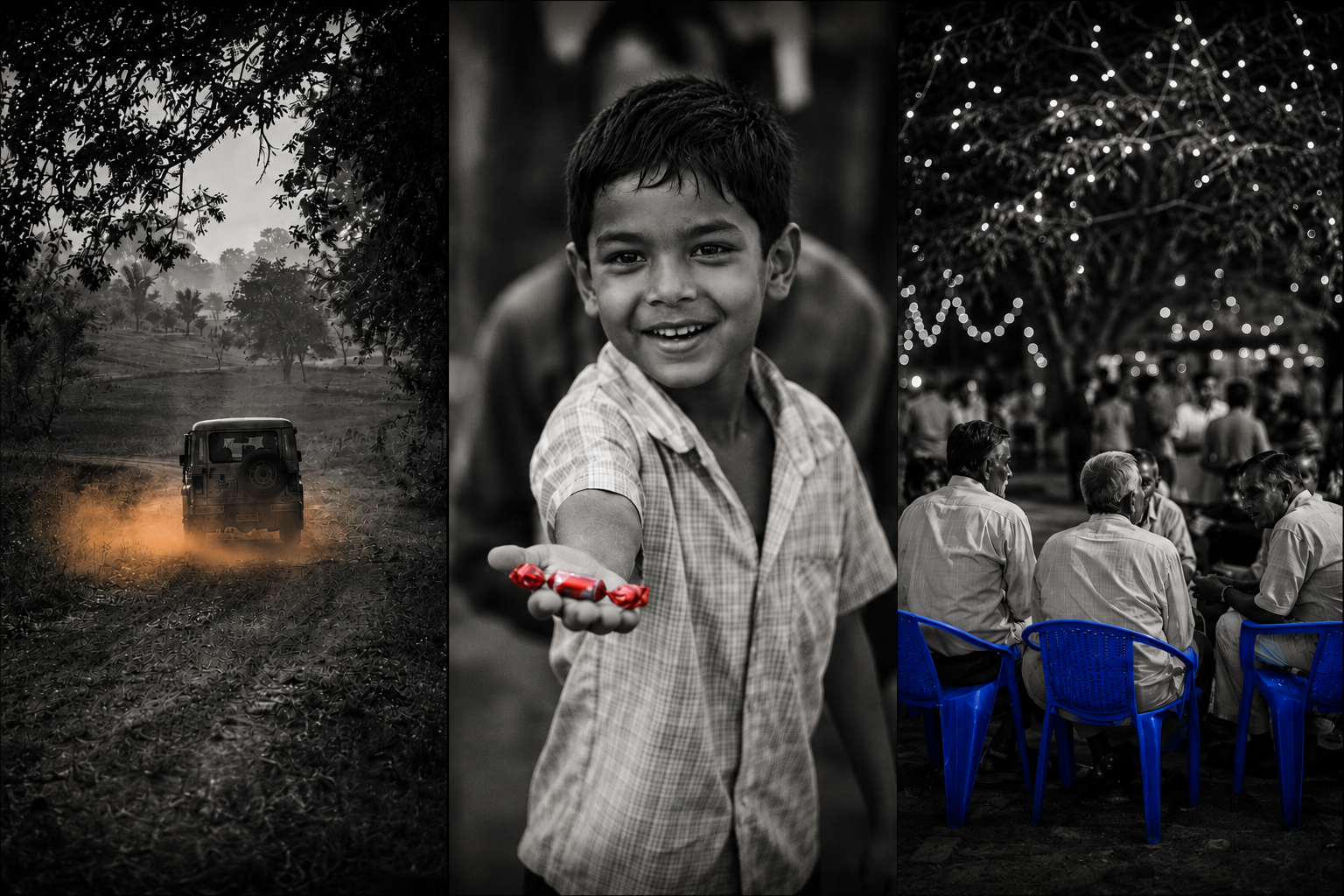
Our vehicle moved slowly through this diminishing world, lifting a long pale wake of dust into the crimson evening. For several seconds after we passed, the dust remained suspended above the road before settling invisibly upon whatever lay beneath it. There was something consoling in these small disappearances. Smoke vanished above distant houses. Birds dissolved into the dark line of trees. The last brightness slipped from ponds without ceremony. Nothing announced that it was leaving. It merely became harder to see.
At intervals the countryside produced something strangely out of proportion to its surroundings: a high wall crowned with barbed wire, an enormous house set far back among trees, an iron gate protecting a property from people who seemed nowhere to be found. We passed one such wall shortly before sunset.
“Who lives there?” I asked.
Madan glanced towards it.
“I don’t know, sir.”
“You drive through here and don’t know?”
“I drive on the road. I am not required to know what happens behind every wall.”
“A very disciplined philosophy.”
He smiled.
“Also safer.”
Then, after a moment, he added, “In villages people build small houses and know everybody. In cities people build large houses and try not to know anybody. Perhaps this house could not decide which it wanted.”
It was the first interesting thing he had said all afternoon.
Until then I had known him only in the narrow manner in which passengers know drivers: his name, his punctuality, the back of his head, his habit of adjusting his white company cap whenever the road became difficult. There are people with whom we spend entire days while knowing almost nothing about them. They carry us, cook for us, clean rooms after we leave, bring food to tables, open gates, repair machines. Their lives reach us already compressed into their occupations.
Driver.
Waiter.
Guard.
Cleaner.
It rarely occurs to us that the person performing the function has been living an entire life before entering the room.
The Road Beyond the Map
Three hours of uneven roads had meanwhile consumed most of my enthusiasm for the wedding. At a lonely bifurcation, Madan slowed the vehicle beneath a large tree.
“Which one?” I asked.
“That is what I am going to find out.”
He pointed towards two tracks. The one on the right descended towards waterlogged fields; the left disappeared behind a low ridge.
“I thought drivers were supposed to know the road.”
“Drivers know roads, sir. Monsoons make new ones.”
He climbed out before I could answer.
I followed and settled upon the trunk of a fallen tree lying half-buried in grass. It seemed too large for anyone to have bothered carrying away for firewood. The air had cooled. I lit a cigarette and watched the smoke rise.
The countryside stretched away in wide irregular planes of gold. Harvest was near. Ponds lay between the fields, holding pieces of the changing sky. An ox walked alone along a narrow path, evidently more certain of its destination than we were. Far above the fields, birds circled before drifting towards darker trees.
Two kites moved against the evening.
They were too distant for the children flying them to be seen. Only the coloured shapes remained, climbing, dipping, approaching and retreating, occasionally tangling before the wind pulled them apart.
From where I sat, the struggle seemed self-created.
The strings were invisible.
So were the hands.
It occurred to me that much of history is eventually viewed from such a distance. We see collision and consequence, victory and defeat, while the small tensions below—the hands, fears, rumours, loyalties and grievances pulling upon events—disappear.
Madan returned while I was still watching them.
“The villagers say the left road, sir.”
“The longer one?”
“Yes.”
“How much longer?”
“Half an hour. Perhaps forty minutes.”
“And the right?”
“The rain has washed away part of it.”
“So if we take the right we save half an hour?”
He considered this.
“If the road is still there.”
There was a pleasing economy in the answer.
“Left, then.”
As we walked back he added, “We should still reach before the main ceremony.”
“You said that two hours ago.”
He looked towards the fading sky.
“Two hours ago I had more evidence.”
I laughed.
So did he.
It was a small thing, but afterwards the formality between us seemed slightly thinner.
We drove on.
The Children Who Remembered
The village appeared almost without warning. Two boys emerged from behind a hedge and began running alongside the vehicle. Then three more joined them. Within moments children were pouring from courtyards and between houses, shouting and waving.
I lowered the window and waved back.
Their excitement increased.
“Quite a reception.”
Madan said nothing.
After several seconds I realised the children were hardly looking at me.
“They know you.”
“Some.”
“Some? Half the village is chasing the car.”
He smiled.
“It has been many years.”
The children gradually fell behind.
“You cannot tell me that was merely a village welcome. I was waving like a visiting dignitary while the entire procession was apparently meant for you.”
“Children do not care much for dignitaries, sir. Unless the dignitary carries sweets.”
“So that is your secret?”
“It used to be. Jaggery mostly. Chocolates when I had money. Chocolates were dangerous. Once you brought chocolates, jaggery became an insult.”
“And those children remember?”
“No, sir. Not those children.”
He paused.
“Those children would be grown men now. Some probably have children of their own. Perhaps that is who came running.”
Something in the correction carried more time than the sentence itself.
“You still haven’t answered why they know you.”
“I used to come through here often.”
“For work?”
“Yes. Although after a while it became difficult to say exactly what my work was.”
“What does that mean?”
“A job sometimes changes without anyone changing your designation.”
I smiled.
“That sounds suspiciously philosophical for a chauffeur.”
“Long roads are bad for drivers, sir. Too much time to think.”
“Then tell me the long story.”
He glanced at me through the mirror.
“There isn’t much.”
“Whenever someone says that, there usually is.”
The road climbed gently. Dark clouds had begun collecting beyond the hills.
After some time he began.
The Man Behind the Occupation
Many years earlier, he had driven independently for hire. In those days several villages farther inland had little electricity and fewer roads. Some possessed street lamps along a central lane; beyond them darkness returned almost intact.
“We used to joke that after the last electric pole even the government forgot the place existed.”
“There were really villages that isolated?”
“Hundreds.”
“And you knew them?”
“I thought I did. Then one afternoon a gentleman came asking me to drive somewhere whose name I had never heard.”
He smiled at the memory.
“It was terribly hot. Even dogs had stopped barking. I thought he had the wrong district.”
“What did he want there?”
“There were sick people waiting.”
“Could they pay?”
“That was exactly what I asked.”
“And?”
“He said he didn’t know.”
Madan laughed softly.
“That confused me more than anything. If they could not pay, why was he going? If he didn’t know whether they could pay, what sort of arrangement was this?”
“Yet you took him.”
“He was paying me.”
“Ah. So altruism entered later.”
“Much later, sir.”
His frankness made me laugh.
“The road became worse. Eventually it ended. I told him, ‘This is as far as the vehicle goes.’ He picked up his bag and said, ‘Then we walk.’ As if that solved everything.”
“How far?”
“Five or six kilometres. In that heat it felt like fifty. Then he handed me another bag.”
“You were hired to drive.”
“Exactly. I remember being deeply offended.”
“What did you do?”
“I carried the bag.”
“Why?”
“I had already travelled too far to preserve my dignity.”
We both laughed.
Then his expression changed.
“When we reached the village, I understood why people were not coming into town. Some were ill in ways I had never seen closely. Their hands, their faces…”
He slowed to avoid a rut.
“I was frightened.”
There was no embarrassment in the admission.
“People remember themselves kindly after many years. They say, ‘I was never prejudiced, I was never afraid.’ I was. I stood away.”
“And the man you drove?”
“He didn’t say anything to me. That was important. Had he lectured me, perhaps I would have become stubborn. Instead he sat beside an old man and examined his hands.”
Madan briefly lifted one hand from the wheel.
“He touched him. That was all.”
“And that changed you?”
“Not immediately.”
He shook his head.
“These things sound beautiful when told later. Real change is less beautiful. I stood there. Next time I carried something closer. Another time I helped someone into the vehicle. After several visits I stopped thinking about where I stood.”
He paused.
“Perhaps people change that way more often than we admit. Not because someone wins an argument, but because they repeat a different behaviour until the old fear becomes inconvenient.”
I settled deeper into the seat.
“How did one journey become years?”
“He called again. Then again. Eventually I kept certain days free because I knew he would call.”
They travelled through settlements scattered among forests and low hills. Sometimes roads vanished in the rains. Sometimes patients had to be carried. Sometimes they slept in schoolrooms or beneath whatever shelter was available. Children learned the sound of the vehicle.
“Those were your jaggery thieves?”
His face softened.
“Terrible criminals. Biscuits, pens, coins from the dashboard. Once a boy stole my handkerchief and wore it around his neck for months.”
“You let him?”
“What could I do? Ask a six-year-old to return my property?”
“You became attached.”
“Yes.”
He said it quietly.
“Very much.”
The road stretched ahead.
“You once said those were the best years of your life. Why?”
He thought for a long time.
“Because I knew why I had got up that morning.”
The simplicity of the answer surprised me.
He continued.
“Most of life is not like that. We wake, earn money, pay bills, quarrel, worry about things, buy something and then worry about losing it. Nothing wrong with that. Families must eat. Children need school. But during those years, even when I was tired, I rarely wondered what the day had been for. If we brought one person to treatment, enough. If medicine reached somewhere, enough. If a child saw the vehicle and smiled because he knew there was jaggery inside, sometimes even that was enough.”
He shook his head.
“I wasn’t saving the world. I was driving a vehicle. But for the first time the smallness of what I did did not make it meaningless.”
The first drops of rain struck the windscreen.
“And then?”
His expression altered.
When Fire Changed Its Meaning
“Then came January.”
Rain spread rapidly across the glass. He switched on the wipers.
“We had been staying near one village for almost two weeks. It was cold. We were supposed to leave the next morning. I remember being happy about going home.”
“Why do you say that as though it troubles you?”
“Because after something terrible happens, you examine everything you felt before it, as though happiness itself had been careless.”
The rain grew heavier.
“There was a fire outside. We ate beside it. Some workers joined us. Two boys sat near the fire. The younger one had a book.”
“What kind?”
“I don’t remember. Something about the sky. He kept looking at the page and then upward. He was trying to find a constellation.”
“Which one?”
Madan smiled sadly.
“I knew you would ask.”
“And?”
“I don’t remember.”
He looked ahead.
“I remember the finger. I remember the way he tilted his head. I remember firelight on the page. But I cannot remember the stars.”
The wipers moved back and forth.
“Memory is unfair like that.”
There is indeed a peculiar cruelty to memory. It preserves without consulting importance. A voice disappears while the pattern of a shirt remains. A face blurs while a cup upon a table becomes painfully exact. The mind is less an archive than a house after a storm: only afterwards does one discover what happened to survive.
“There was a radio,” Madan continued. “Someone was trying to find a station. We were leaving in the morning. Everyone was tired.”
He paused.
“It had been an ordinary night.”
Perhaps that was the saddest sentence.
An ordinary night.
Before catastrophe, the final hour does not identify itself. Someone yawns. Someone turns a page. A cup remains unfinished. Plans are made for breakfast.
Then the morning belongs to another world.
“What happened?”
“They came late.”
He did not say who.
I did not ask.
“I remember waking with pain. Someone had struck me. My cheek was against the ground. I could smell the earth. I tried to get up and couldn’t.”
His breathing changed.
“Then there was smoke.”
“The fire?”
He met my eyes in the mirror.
“No, sir.”
Then he looked back towards the road.
“That troubled me for years. Only a little earlier fire had kept us warm. We had cooked beside it. The boys had sat near it.”
His hands tightened upon the wheel.
“Then fire became something else.”
For a long while only the rain spoke.
“I could not sit comfortably near bonfires afterwards. People thought I was afraid of fire.”
“Weren’t you?”
“No.”
He shook his head.
“I was afraid of how quickly a thing could change its meaning.”
Nothing I could have said would have improved the silence that followed.
After several miles he continued.
“We like to think good things and bad things belong to different worlds. A warm fire belongs here. Hatred belongs somewhere else. A child looking at stars belongs here. Violence belongs somewhere else. But sometimes there is only a minute between the two.”
“What did you do afterwards?”
“Nothing brave. I survived.”
He spoke without drama.
“For a while I hid because I was frightened. Then came police, questions, people wanting everything in the proper order. Who came first? What was said? How many? Which direction?”
He gave a tired smile.
“But memory does not stand in a queue. I remembered what nobody asked and forgot what everyone wanted.”
“The boy with the book.”
“Yes.”
“The radio.”
“Yes.”
“The fire.”
He nodded.
“And sometimes jaggery.”
“Jaggery?”
“There was some in the vehicle.”
He laughed softly.
“For years the smell could take me back there.”
His eyes had become wet.
I turned towards the window.
Outside, the fields had disappeared into darkness.
Voices With Space to Travel
After some time he pulled over.
“Sir, may I stop? I need to eat something.”
“Of course.”
He switched off the engine.
We stepped outside.
The rain had polished the night. Water filled the fields, holding broken reflections of the moon. Old telegraph wires crossed overhead. Somewhere a dog barked. Then laughter travelled across the darkness from a house too distant to see clearly.
A woman called someone.
Metal struck stone.
A door closed.
The countryside appeared empty yet continually betrayed the presence of hidden lives.
“Funny,” I said. “You can hear everything out here.”
Madan was eating quietly beside the vehicle.
“In the city there are too many sounds,” he said. “Here one sound has enough space to travel.”
“Perhaps that is why old memories survive better in villages.”
He smiled.
“Old memories survive everywhere, sir. Cities just give you more places to hide from them.”
I looked at him.
“You have been thinking too much again.”
“I warned you about long roads.”
We remained there a little longer.
Perhaps the past survives much as those distant voices did. The rooms disappear, the faces become inaccessible, yet occasionally a sound travels across the years: a sentence, a gesture, a story told beside a road.
Then darkness closes around it again.
The Privilege of Ordinary Problems
It was late when we reached the wedding.
My friend greeted us with exaggerated relief, complained about the lateness and embraced me before I could offer an excuse. Within minutes the road seemed to belong to another existence.
A vast old tree stood at the centre of the celebration. Hundreds of tiny lights had been threaded through its branches and trembled among the leaves whenever the wind moved. Beneath them people ate, argued, laughed, posed for photographs and pursued children who had discovered that weddings temporarily suspend ordinary discipline.
After the empty roads, such an abundance of human presence felt almost excessive.
For a while I allowed myself to disappear into it.
Several hours later Madan found me beneath the tree.
“Sir, did you notice the plaque?”
“What plaque?”
He pointed towards the low concrete boundary around the trunk.
I bent towards it.
“What am I supposed to see?”
“Not the plaque.”
He nodded towards the guests.
“Then what?”
“Some of the people here were once patients.”
“From those villages?”
“Yes.”
He pointed discreetly.
“We used to bring people like them for treatment. In those days others were afraid even to sit beside them.”
I looked across the gathering.
“And now?”
He smiled.
“Now they complain about the wedding food like everyone else.”
I laughed.
“So this is progress?”
“I think complaining about catering is a very advanced stage of recovery.”
His humour caught me by surprise.
Then he became serious.
“One family here was among the first we used to visit. I hadn’t seen them for years.”
I looked again.
An elderly man ate slowly from a plate. Two women whispered together. A young mother rearranged flowers in another woman’s hair. A child slept across two plastic chairs.
There was nothing extraordinary about them.
The absence of extraordinariness suddenly seemed extraordinary.
“Do they remember you?” I asked.
“Some do.”
“And the man you travelled with?”
Madan looked at the lights.
“Of course.”
Then he reconsidered.
“Perhaps not the younger ones.”
“Does that bother you?”
He took his time answering.
“When I was younger, maybe it would have.”
“Why not now?”
“Because perhaps being remembered is not the important part.”
“What is?”
He looked towards the sleeping child.
“That.”
“A sleeping child?”
“A child who can afford to be bored at a wedding. A family arguing about food. Someone worrying whether the flowers match the clothes.”
I waited.
“These are ordinary problems, sir. People underestimate the privilege of having ordinary problems.”
That sentence struck more deeply than I expected.
He raised his glass.
“We think when someone dies, everything they did dies with them.”
“And you don’t?”
He nodded towards the gathering.
“Look around.”
Then he continued, slowly.
“Sometimes a person disappears and what they did becomes someone else’s ordinary life. Perhaps that is better.”
“Better than what?”
“Being remembered.”
I frowned.
“You cannot mean that.”
“Why not?”
“Surely everyone wants to be remembered.”
“Yes. Because we are alive.”
He smiled.
“The dead may have different priorities.”
“You have become philosophical again.”
“No, sir. Just old.”
“You’re not that old.”
“Then the roads have aged me.”
We stood beneath the tree.
After a moment I asked, “Suppose nobody remembered. Suppose even the story disappeared. Would the good still matter?”
Madan looked at me with an expression suggesting that I had made something unnecessarily complicated.
“If a man digs a well and fifty years later nobody remembers who dug it, does the water become less useful?”
I said nothing.
He continued.
“Maybe memory is for us. Life does not need to remember where everything came from.”
He drank.
“Sometimes the person goes and the work stays. Sometimes even the work disappears, but what it changed remains.”
He looked once more towards the crowd.
“That should be enough.”
Then he walked away.
What Survives Being Forgotten
Much later I wandered towards a pond at the edge of the village.
The music softened behind me until only a distant pulse remained. The night was nearly finished. Stars were disappearing one at a time.
As a child I had sometimes watched dawn and wondered where the angels went when morning came. Growing older supplied better answers. Stars became distant suns. Dawn became planetary rotation. Darkness became the absence of visible light. Angels became mythology.
The universe grew more accurate.
It also became, in some quiet manner, less intimate.
That morning the old question returned in another form.
Perhaps childhood had made only one mistake.
It had looked towards the sky.
The first light entered the pond almost imperceptibly. Black became grey, then silver. A bird called. Another answered.
The world slowly recovered its nouns.
Tree.
Water.
Road.
House.
Face.
And then the old story of fire returned to me.
Humanity once lived in darkness, the story says, until fire was taken from the gods and carried down to earth. We call the gift knowledge, civilisation, progress. Fire warmed the body, cooked food, hardened metal, illuminated the night. Eventually it gave us engines, electricity, cities and machines.
It is a comforting interpretation.
But perhaps the gift was more ambiguous.
Fire knows nothing of goodness.
It warms the hand and burns the house with equal sincerity. It illuminates a manuscript and consumes a library. It cooks a child’s meal and becomes a weapon against another child.
Perhaps what was stolen was not light.
Perhaps it was possibility.
And possibility does not instruct the hand receiving it.
The same creature capable of crossing a forest to sit beside someone whom society refuses to touch is capable of joining a crowd and turning another human being into an enemy.
Nothing supernatural separates the two.
That is the troubling part.
They are made of the same material.
Perhaps civilisation is simply the long argument between these impulses. One part of us constructs the boundary; another crosses it. One whispers, not ours. Another asks why that should matter. One withdraws its hand. Another reaches forward.
We like to believe education, prosperity, law and technology eventually settle this argument.
History suggests otherwise.
The argument merely changes clothes.
A civilisation may illuminate every street while leaving great chambers of the human heart untouched.
The wedding lights were still burning behind me, though daylight had exposed their ordinariness: cheap bulbs, wires, plastic fittings tied around branches.
Yet knowing what they were did not diminish what they had done during the night.
Perhaps goodness is like that.
Up close it is usually made from inexpensive things.
A meal.
Medicine.
A seat offered.
A wound cleaned.
A child carried.
A stranger driven home.
A decision to remain when leaving would have been easier.
Most disappear before anyone thinks to record them.
Yet perhaps the world rests more securely upon these forgotten acts than upon the monuments it builds to remember itself.
The Fire We Carry for One Another
By sunrise the first cars were leaving.
I returned to the vehicle. Madan started the engine.
For several miles neither of us spoke.
Morning had transformed the road. Schoolchildren walked along the verge. Smoke rose from tea stalls. Women carried bundles. Men waited for buses. The menace of the previous night had vanished.
The machinery of ordinary existence had restarted.
Eventually I said, “Madan.”
“Yes, sir?”
“I’ve been thinking about your well.”
“My well?”
“The one nobody remembers digging.”
He laughed.
“I had forgotten it already.”
“That rather proves your point.”
He glanced at me through the mirror.
“What are you thinking?”
“That perhaps forgetting isn’t always the opposite of remembering.”
He waited.
“Perhaps something can survive without being remembered.”
“Of course.”
“You say that very easily.”
“Because you are making it difficult.”
“How?”
“You want the good thing to know it survived.”
I considered this.
“And you don’t?”
“A mango tree doesn’t know who planted it.”
“That is hardly philosophy.”
“Good. Then perhaps it is true.”
I laughed.
The road continued.
After a while I asked, “Do you ever wish that night had never happened?”
His answer did not come quickly.
“Every day for many years.”
“And now?”
“Now I know wishing is another way of visiting a place that no longer exists.”
He paused.
“I still wish it. I just don’t expect an answer.”
There was no bitterness in his voice. Only the exhaustion of an argument long concluded.
“Did it change you?”
“Everything changes us.”
“That is an escape.”
“Yes.”
He smiled.
“So ask better.”
I thought.
“Did it make you lose faith in people?”
He considered this more carefully.
“For some time.”
“And what brought it back?”
“People.”
The answer irritated me.
“That is circular.”
“Life often is.”
He continued before I could object.
“The people who did terrible things were people. The people who hid me were people. The people who helped afterwards were people. The children running after our vehicle were people. If I condemn humanity because human beings can be cruel, I must also explain why human beings can be kind.”
He slowed as a herd of goats crossed the road.
“I could never solve that.”
“Perhaps there is no solution.”
“Then we should stop demanding one.”
The goats passed.
He accelerated gently.
“Maybe a human being is not one thing, sir. Maybe that is the mistake. We want someone to be good or bad, brave or cowardly, believer or unbeliever. It makes stories easier.”
“And reality?”
“Reality is inconvenient.”
He smiled.
“A frightened man may still do something brave. A kind man may carry hatred somewhere inside him. A cruel man may love his child. We contain too many rooms.”
“And which room is the real one?”
Madan looked at me in the mirror.
“The one we keep entering, perhaps.”
The road divided ahead.
Without slowing, he took the left.
“You didn’t ask anyone this time.”
“No.”
“You know the road?”
“Now I do.”
Something about those three words seemed to complete a thought neither of us had deliberately begun.
I looked through the window.
The fields were bright beneath the morning sun. Somewhere beyond them lay villages we would never enter, houses whose occupants we would never know, people carrying private histories no traveller passing along the road could possibly imagine.
Fourteen hours earlier Madan had been merely the man driving the car.
Now I knew about the children, the sweets, the book, the fire, the smell of wet earth, the years he had hidden inside an occupation I had mistaken for the whole of him.
Perhaps every stranger contains such a country.
Most of the time we pass without entering.
The vehicle gathered speed.
I thought again of the ancient fire.
Perhaps the old bringer of flame was never meant to be a single heroic figure. Perhaps the myth endured because it recognised something stubborn and unresolved within us: alongside our astonishing capacity for cruelty persists an equally unreasonable capacity to carry something of ourselves towards another person.
It does not redeem humanity.
Perhaps nothing can.
Redemption is too clean a word for a species such as ours.
But somewhere, even now, someone is entering a room others avoid. Someone is carrying medicine along a road absent from maps. Someone is feeding a child who will never remember the hand. Someone is refusing to join a crowd. Someone is crossing a boundary inherited from people long dead. Someone is digging a well whose water will outlive the memory of the person who dug it.
No mountain trembles.
No god speaks.
No one records the moment.
The world continues looking entirely ordinary.
Yet a little fire passes from one human being to another.
Perhaps that has always been the real theft.
Not that we learned how to make fire, but that somehow, despite everything we subsequently did with it, we also learned how to carry it for one another.
The road stretched ahead beneath the morning.
I closed my eyes.
After some time, without opening them, I asked, “Madan, do you still carry jaggery?”
There was a long pause from the front.
Then I heard him laugh.
“Sometimes, sir.”
“For the children?”
“Who else?”
I opened my eyes.
He was smiling at me through the rear-view mirror.
Outside, another village was approaching.
And somewhere beyond the first houses, children had already begun to run.