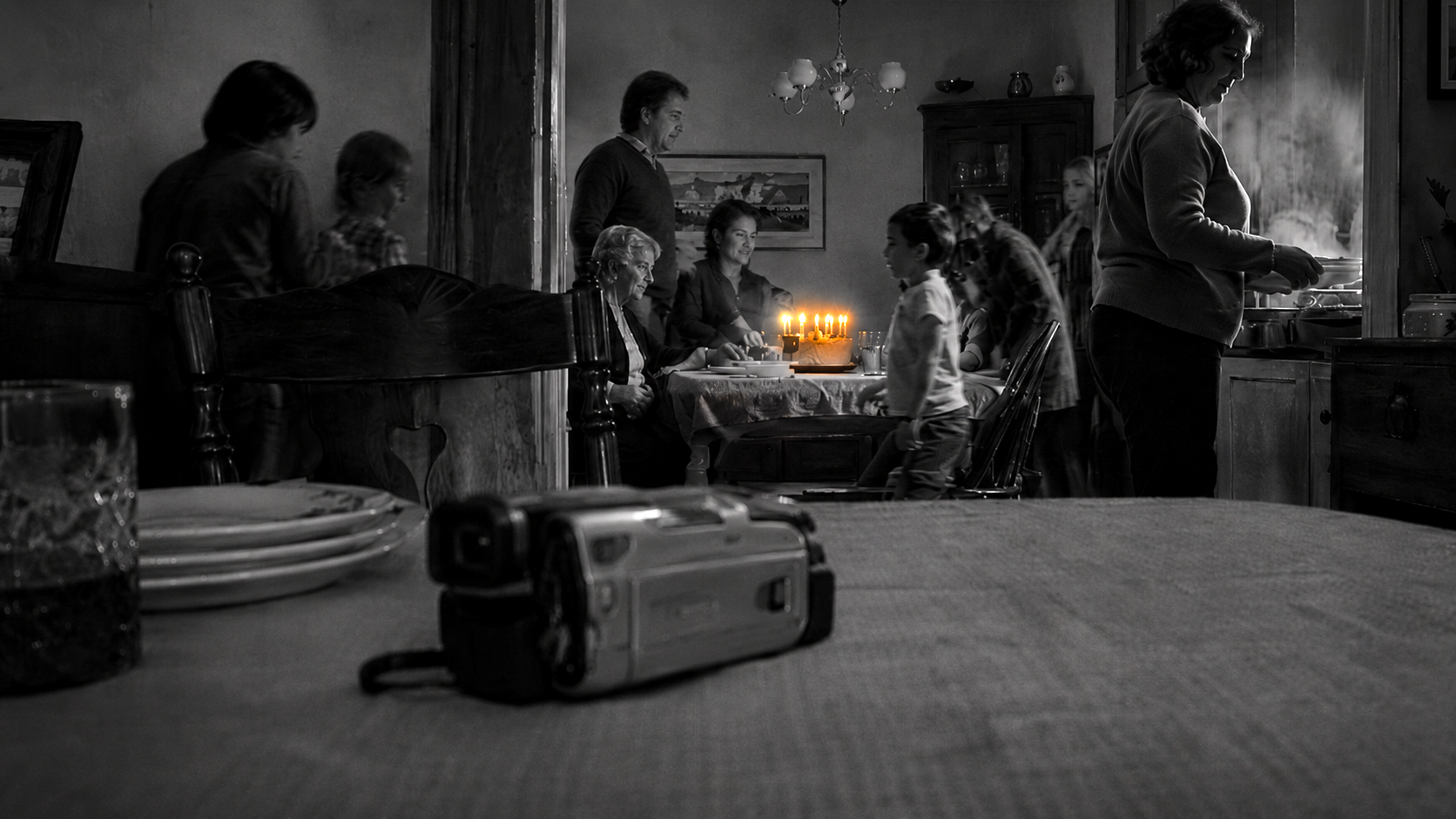
That is often how the past chooses to return: without ceremony and almost without dignity, lying among old cassettes in a plastic box whose lid has yellowed at the corners, each tape carrying a few hurried words written years ago by a hand that apparently believed those words would always be sufficient—Birthday, School, Trip, Christmas, a date here, a question mark there—and for a while you turn them over without feeling very much, surprised perhaps that these little black rectangles once contained whole afternoons, rooms full of people, voices, weather, clothes, quarrels, children, entire houses compressed into magnetic ribbon no wider than a finger. One cassette is inserted, the machine hesitates, the screen trembles into blue and then static, and finally there appears the unsteady geometry of a room you once knew so well that there was a time when you could have crossed it in darkness without touching a wall, although at first you do not recognise it, because recognition after many years does not always arrive as a whole place; objects return before rooms do, and so you notice the chair first, then the curtain behind it, then the cabinet whose lower door never quite closed, and only afterwards does the room gather itself around them until you realise that you are looking into a place which for several years contained nearly everything you understood by the word home.
Seven Minutes of Nothing
The camera is pointing slightly downward and nothing appears to be happening. A piece of floor occupies much of the frame, the leg of a chair cuts into another part, and somewhere beyond the camera somebody is moving metal plates while a voice from another room remains too indistinct to understand. You almost fast-forward, because the birthday must be farther ahead and that, after all, is what the label has promised you, but then a child runs across the frame wearing only one sock and you stop. The child disappears; nothing follows, and from the kitchen a pressure cooker releases steam with that long irritated sigh pressure cookers used to make in houses before anyone considered domestic sound worthy of preservation; someone asks where the matches have gone, another person answers from somewhere farther inside, a door opens and lets the street into the house for several seconds—horns, a bicycle bell, perhaps a vendor, perhaps only traffic—then closes again, and the house settles back around its own noises. Somewhere a woman laughs. You recognise the laugh before you recognise whose it is. Then an older voice says something completely unimportant, perhaps asking whether tea has been made, perhaps whether somebody remembered coriander, and although the sentence itself has deteriorated beyond certainty, the voice has not.
You sit very still because there are photographs of this person, good photographs, some carefully framed, one in which the person is dressed properly and looking straight towards the camera, another in which everyone has arranged themselves around a table and, because photographs require a brief surrender to stillness, they have all become those strange public versions of themselves intended for a future viewer. Yet this voice was not intended for you, and perhaps that is why it reaches farther. It belongs entirely to that evening. Nobody knew anyone would listen decades later, nobody lowered a voice into significance, nobody searched for a sentence that might survive them; the person spoke because somebody nearby needed to know something unimportant, and then the room continued. Perhaps this is what becomes hardest to understand about those who are gone: most of their lives were not composed of the things for which we later remember them, but of asking where the scissors were, complaining that the tea had gone cold, calling someone to shut the gate, clearing a throat, looking outside at rain and deciding whether it would last. An insignificant sentence can sometimes reach us more completely than a carefully preserved photograph because the photograph has already accepted its duty as memory, while the sentence still believes it is merely alive.
The camera continues watching the chair, and you continue watching the camera watch the chair. Seven minutes pass in which nothing important happens and years have somehow made these seven minutes more compelling than what follows, because eventually somebody notices that the camera is recording, lifts it abruptly, and the room swings upward in a blur—a ceiling fan, half a face, a window, a wall—while several people laugh at the mistake. Then the person holding the camera finds the birthday child, the cake arrives, chairs are pulled closer, someone complains that another person is blocking the view, the candles are lit, the lights switched off, and suddenly everybody understands that something worth remembering is about to occur. Faces turn towards the lens, somebody says to wait, someone else says begin, everyone sings, the child blows, the candles disappear, applause fills the room. It is happy, certainly, but almost disappointing in its familiarity, because it resembles every other preserved birthday and, unlike those first seven minutes, it knows it is being remembered.
What the Camera Did Not Mean to Preserve
So you rewind. The chair returns, the strip of floor, the steam from the kitchen, the child with one sock, the old voice from beyond the frame, and now you begin noticing things which would have remained entirely beneath notice while you lived there: the particular darkness beneath the cabinet, the scratched edge of a table, a folded newspaper, the faint stain spreading outward from the leg of something heavy, the old switchboard near the door, the curtain whose pattern you had forgotten so completely that seeing it again opens some inaccessible chamber of memory with embarrassing ease. You remember touching that curtain. More strangely, you seem to remember how it felt. For years the curtain has not existed in your conscious life and yet your fingers appear to have kept it, which is one of the ways the body continues to embarrass the mind: a staircase appears and suddenly the feet remember its height, a smell returns and an entire monsoon follows it, somebody hums three notes of an old song and a road not thought about in thirty years becomes momentarily more real than the road outside the present window.
Perhaps memory has never lived mainly where we imagined it lived. Perhaps it has always been scattered through muscle, smell, posture, rhythm, through the angle at which a hand reaches automatically towards a switch that no longer exists. A house enters you through thousands of small agreements: you know which door must be pulled slightly before it can be locked, which floor tile sounds hollow, where afternoon light becomes unbearable in summer, which tap must be turned farther than seems reasonable before water comes. Nobody teaches these things formally and eventually nobody remembers learning them; they become simply the way the world works. Then one day you leave, the world begins working differently somewhere else, and this private body of knowledge becomes useless, although useless knowledge does not necessarily vanish. It may simply sleep until an old video wakes it.
The room on the tape seems smaller than you remembered, which is one of the recurring humiliations of returning to childhood places, because memory enlarges spaces according to the body that first inhabited them; a corridor crossed on small legs becomes long, a courtyard becomes a field, the walk to a nearby shop becomes a journey involving weather, danger, landmarks and decisions, and many years later an adult can stand at one end of the same distance and see the other too easily. Perhaps the room was always this small. Perhaps it was not the room that was large but the life inside it.
People move through the doorway. Some you know immediately, others require a few seconds, and then one person crosses so quickly that you cannot decide who it is, so you rewind and watch again: a blurred shoulder, hair, the side of a face. You know them. You have not thought of them for years. They are carrying plates from one room into another and never appear again in the recording. Three seconds have survived, and suddenly three seconds do not seem negligible. You rewind once more and the person crosses again, forever carrying the same plates, never tiring, never looking towards the camera, never becoming older than they were on that evening, while you grow older each time you press rewind. Recording gives us the illusion that return and repetition are the same thing, but they are not. The person on the tape returns unchanged. The person watching never does.
Photographs have always contained this inequality. The people inside remain loyal to an instant while the person holding the photograph continues travelling. At twenty you look at yourself at ten and feel distance; at forty you look at the same photograph and realise that both children—the ten-year-old in the image and the twenty-year-old who first looked back at them—have disappeared into you. Time does not simply move forward; it gathers witnesses, so that an old photograph may eventually contain three, four, five versions of the person looking at it, layered invisibly behind the same pair of eyes. This may be why certain photographs become heavier with age although the paper has not gained a gram. The image has accumulated viewers, all of whom were you.
The Things Memory Keeps
Perhaps because of the ceiling fan in the recording, you remember an evening when the electricity failed across the neighbourhood. There is no photograph of it and you cannot say which year it happened; perhaps it happened many times and memory has fused several power cuts into a single evening. The fan slowed until individual blades became visible and then stopped altogether, the television vanished in the middle of a sentence, refrigerators fell silent, and for several seconds there was an extraordinary emptiness before human beings began filling it. Doors opened, windows opened, people distributed through separate rooms gathered near balconies and verandas, someone found candles, somebody complained about mosquitoes, children treated the collapse of infrastructure as a festival, neighbours appeared, voices crossed property lines that electricity normally kept intact, and the street became darker yet somehow more inhabited. Then the current returned. Fans jerked back into life, lights flared, someone cheered, and within minutes the doors had closed again and every house withdrew into itself.
You cannot be certain that this happened exactly as you now see it. Memory is careless about dates and shameless about editing. Two summers may become one, one person’s words may migrate into another person’s mouth, rain may be added because rain belongs emotionally to the memory even if the weather that day was clear. A historian might object, but memory has never promised minutes and dates; sometimes it preserves something less precise and more stubborn—the temperature of being there, the length of an afternoon, the scale of a room, the feeling of waiting for somebody who had not yet returned, the unease before examination results, rain against metal, the smell of clothes dried in sunlight, a bicycle bell heard from bed. These things often survive not because they mattered when they occurred but because some hidden part of us chose them without consultation.
That is unsettling because we spend so much of life trying to decide deliberately what deserves remembrance. We photograph ceremonies, preserve certificates, save invitations, report cards, wedding clothes, announcements, important dates, while memory behaves with poorer manners, keeping the cracked cup, the neighbour’s radio, someone’s peculiar sneeze, the smell outside a cinema, an afternoon when nothing happened except that the light was beautiful and nobody thought to say so. Perhaps the camera accidentally abandoned on the table understood something that the person holding it did not, because the moment it was lifted it began pursuing significance—faces, cake, candles, smiles—while before that it had merely received whatever happened to cross its field.
You begin to wonder whether living itself may work in much the same way, whether the harder we aim at the important portions of life, the more easily we miss the strange unrepeatable texture surrounding them. A wedding is remembered while the morning before it disappears. A graduation survives while the bus ride home does not. A holiday becomes a destination and several landmarks while the night somebody could not sleep and listened to rain through an unfamiliar window vanishes. Perhaps what we call a life is disproportionately composed of the parts nobody photographs: months spent falling in love and one afternoon getting married, years raising a child and two hours at graduation, thousands of evenings beside another person and one anniversary documented carefully enough to enter an album. The ceremony is an island. The ocean is Tuesday.
When the Dead Re-enter the Room
Another face appears on the tape and you immediately know that this person is dead, and it is remarkable how death changes the way an old image is read despite changing nothing within the image itself. The person is laughing. Before their death it would have been merely laughter; afterwards the same movement acquires a border because you know something the person inside the image does not. Every old recording contains these asymmetries. Someone is worrying about money and does not know that later they will have enough. Someone standing beside a spouse does not know that the marriage will end. Someone apparently healthy does not know what diagnosis will eventually enter their vocabulary. Somebody deeply unhappy cannot imagine the life that later rescues them. Someone regarded by everybody in the room as permanent will become a name explained to children not yet born.
They continue moving through the evening innocent of all this, and what you envy is not really their youth but their ignorance. There was a time when the future had not yet acquired evidence: no diagnosis, no departure, no phone call, no knowledge that this ordinary evening would eventually be replayed because someone inside it was no longer available. Perhaps this is the peculiar ache hidden inside nostalgia—not a serious desire to return to unreliable electricity, old furniture, inconvenient houses, primitive cameras or younger bodies, but a desire to stand again among people who had not yet learned what would happen to them, to enter a room before consequence, to hear the ordinary voice while it is still merely ordinary.
Of course, even if the house remained, you could not truly return. The street might survive, perhaps the building, perhaps even the tree near the gate, but you would arrive carrying knowledge, and knowledge changes the place one returns to. You would no longer be the person for whom those rooms were present tense. This is what makes return different from restoration: places can survive; time cannot.
You pause the cassette. A woman is halfway through turning her head, someone’s hand remains lifted in a gesture whose purpose cannot be reconstructed, and the child with one sock has just entered the edge of the frame again. The image is grainy enough that faces soften when enlarged, and there is something merciful in that imperfection. High resolution might have given you pores, cloth fibres, exact colours, everything technology now promises to preserve, whereas the old tape gives you something less complete and perhaps therefore closer to memory: movement dissolving slightly into light, people present but never entirely retrievable. You press play and they recover motion.
The Age of Permanent Memory
You wonder whether the age of permanent recording will produce a different nostalgia. A child now may accumulate tens of thousands of photographs before learning to read; birthdays exist from multiple angles, first steps, meals, school runs, ordinary mornings, voices preserved in high definition, locations time-stamped, faces searchable, entire childhoods backed up remotely in places no child knows exist. Perhaps fewer things will disappear, although disappearance may not be quite the enemy we imagine it is. If everything remained available, what exactly would it mean for something to return? Return requires absence. Surprise requires forgetting. You cannot unexpectedly encounter what has never left.
The cassette had waited for decades without reminding anyone of its existence, and that long silence became part of its power. When opened, it did not merely display the past; it violated an absence. The experience becomes almost geological, like splitting a stone and finding the imprint of a leaf that fell into mud before anyone present was born. The ordinary became precious partly because it had been buried. Scarcity had concentrated it. Perhaps that is why the accidental seven minutes now seem more valuable than the deliberate hour following them.
The Witnesses We Lose
There is another thought, less comfortable, that arrives while the tape continues: as people age, they gradually lose witnesses. Not only people they love, but people who knew earlier drafts of them—someone who remembers you before you became the person everyone now recognises, who remembers what frightened you before you learned not to show fear, who remembers the ridiculous ambition you once held with complete seriousness, the nickname nobody in your present life has heard, the family before the argument, the house before the renovation, the person before illness changed the way everyone spoke to them.
When such people leave, it is not only their history that disappears. A portion of your own goes with them. A parent may be the final living person who remembers you before language; a sibling remembers arrangements of the household unavailable to anybody else; a childhood friend carries evidence of the person who existed before career, marriage, title, reputation. Gradually the witnesses disappear and you remain increasingly responsible for remembering yourself, which may be one reason objects begin acquiring an importance disproportionate to their usefulness: a watch, a cup, a book with handwriting inside, a shirt nobody wears, a chipped bowl, an old key, a cassette accidentally left running. They cannot answer questions and they are poor historians, but they were there.
Perhaps this is why throwing some objects away feels oddly different from disposing of ordinary matter. You are not entirely discarding cloth or metal or paper. You are dismissing a witness.
The Sentence That Would Not Return
You rewind once more to the old voice. Play. The sentence arrives, still unclear. You increase the volume and the static rises with it, but the words refuse to come any closer. Perhaps another person in the family might recognise them; perhaps software could clean the recording now, isolate frequencies, reconstruct syllables. Yet suddenly you do not want clarity. The voice is enough. Meaning begins to feel almost intrusive.
For years you may have imagined that if certain people could return for one conversation you would ask important questions. Were you happy? What did you regret? What did you understand at the end? What should I have asked while there was still time? Yet when an old recording unexpectedly restores someone for a few seconds, wisdom is not what you want. You want them to complain about the weather. You want to hear them call somebody from another room. You want the impatience, the cough, the laugh before the sentence. You want precisely what nobody had the foresight to preserve because nobody had yet understood that ordinariness would become scarce.
Perhaps love becomes clearest after usefulness disappears. While people are alive we need things from them—help, approval, money, advice, forgiveness, answers, presence—and they need things from us; relationships are full of expectation, exchange, failure, responsibility, disappointment, repair. Memory gradually removes much of that machinery and sometimes what remains is startlingly small: a way of sitting, a hand resting on a table, someone peeling fruit, a habitual phrase, the angle of a head while listening. This may be why melancholy and gratitude are so difficult to separate when looking backward, because to ache for something is also to realise that once, inexplicably, you possessed it without understanding that possession was happening.
You were there—when the cooker released steam, when the fan clicked once each revolution, when somebody crossed the room with plates, when the voice came from somewhere beyond the frame. You did not appreciate it enough, but nobody could have. Complete appreciation would have destroyed the evening. Imagine living every ordinary moment under the command remember this, this will disappear. A child could never simply play, a mother could never simply complain, a father could never simply read the paper; everyone would become an actor performing inside their own future memorial. Perhaps one of life’s quieter kindnesses is that it hides endings while we inhabit the middle. We waste time, become irritated, look elsewhere, assume another Sunday, and that assumption may be exactly what allows Sunday to remain Sunday.
The Present the Camera Preserved
The tape moves on. The birthday eventually ends, people begin eating, conversation loosens and the camera is placed down again, but this time somebody remembers to switch it off. The screen becomes static. You eject the cassette and the room around you returns with a clarity that feels almost aggressive: the present table, the present light, the present phone, your own hand, all insisting that now is the only time actually available.
Perhaps tomorrow you will watch another cassette. Perhaps you will not. There is danger in remaining too long among preserved things because the past, once furnished beautifully enough, can become somewhere one begins to live. Yet memory is not necessarily asking us to return, and perhaps it is not even asking us to appreciate the present before it disappears, because that, too, begins to sound suspiciously like advice and life has always been resistant to advice. Tomorrow the cup will simply be a cup again. Someone will interrupt you while you are thinking. A door will slam. You will hurry somewhere. A message will annoy you. Afternoon light will cross a wall and you will probably fail to notice it.
Good. Let some of it remain unobserved. Let life retain a little privacy from memory. Let today believe, for a while longer, that it is merely today.
You place the cassette back inside its plastic case. The handwriting on the label is fading and you close the lid, but before the image disappears completely you see once more those seven minutes nobody intended to preserve: the empty doorway, the chair, the child passing through, the kitchen somewhere beyond the frame, the people speaking without importance, each of them proceeding calmly towards futures they cannot see, while an unattended camera remains on the table, asking nothing of them and knowing nothing.
For all those years you had thought the camera had preserved the past. Now it seems otherwise. The room it recorded was not the past when the camera saw it. The people were not memories. The voice had not yet become precious. Nobody was returning anywhere. Nobody was looking backward. It was simply evening. The camera preserved the present. We were the ones who kept leaving it.